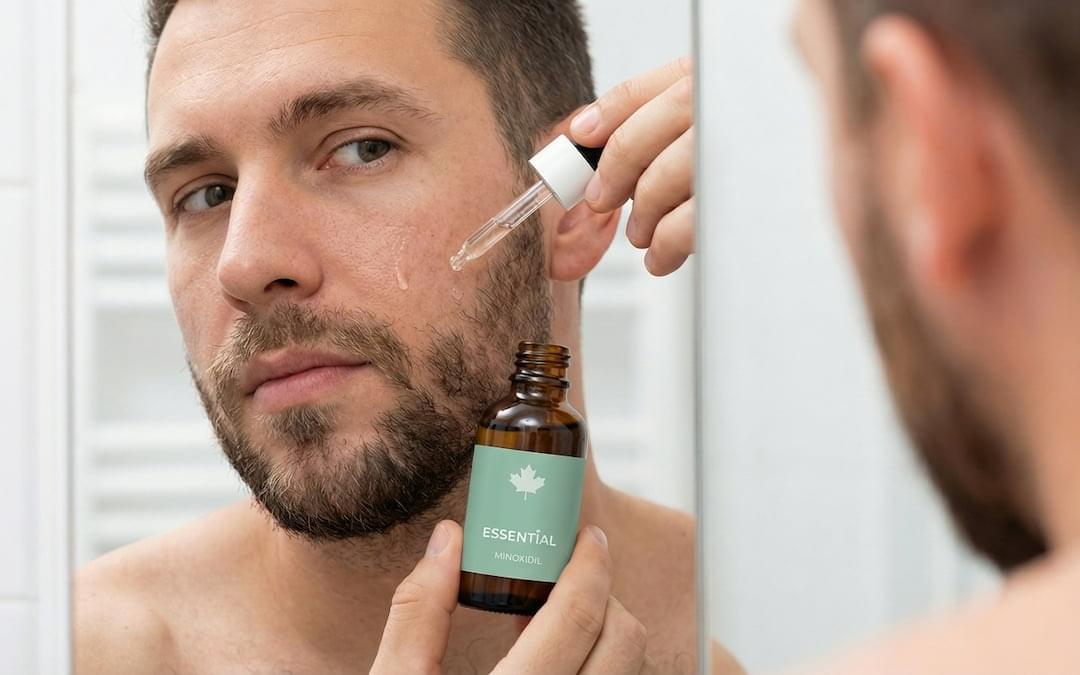
Minoxidil for Beard Growth
Can I Use Rogaine on My Face? Everything About Minoxidil for Beard Growth
Hair loss is one of the top health concerns for aging men: studies show that as many as half of all guys will experience hair thinning or hair loss.
Luckily, there are effective hair loss treatments available in Canada—one of which is minoxidil (also known as generic Rogaine).
Minoxidil is a hair loss treatment that you apply directly to your scalp. It's widely available in Canada either over-the-counter or from online hair loss clinics. Minoxidil has been found to be a safe and effective hair loss treatment for both men and women. It's got great results with few side effects.
But some guys aren't looking for a solution to a thinning scalp—they're looking to grow hair on their face.
So how effective is minoxidil for beard growth?
Here's the scoop—everything you need to know about using minoxidil to fill out your beard.
Want to try? Buy minoxidil online from Essential Clinic.
What is minoxidil?
Minoxidil, sometimes sold under the brand name Rogaine, was discovered in the 1950s. Scientists were looking for a heart medication, and the minoxidil compound was found to be a powerful vasodilator (a substance that dilates blood vessels and promotes blood flow).
Learn More: What is Minoxidil? Your Complete Guide
In clinical trials, researchers noticed that it also had an interesting side effect: it seemed to promote hair growth. After further testing, the compound was eventually approved by the FDA as a treatment for hair loss.
Since then, research has consistently found that minoxidil is effective at reducing hair loss and increasing hair growth in both men and women.
In one systematic review and meta-analysis, minoxidil seems to be effective in solutions at concentrations of both 2% and 5%.
How minoxidil works
Scientists are still unclear about how minoxidil works at the molecular level, although they suspect that it works by increasing blood flow to hair follicles. They believe that the increased blood flow allows the hair to receive more nutrients, which improves its growth.
Minoxidil may also promote hair growth by restarting the hair follicle's growth phase. The compound seems to help hair that's in the resting "telogen" stage of the hair growth cycle to shed, making way for the hair follicle to start the "anagen" phase and grow new hairs. These new hairs are often thicker than the ones they replace, leading to a thicker head of hair.
Does minoxidil work on beards?
So the science is pretty clear that minoxidil works—at least on your scalp. But does it also work on facial hair?
The high-level answer is that it appears to… but there's much less evidence available on this point.
Research suggests minoxidil can help beard hair growth
To our knowledge, there has only been one randomized control study to examine the effect of minoxidil on beard growth. The study, published in the Journal of Dermatology in 2016, found that patients who used minoxidil showed significantly improved hair after 16 weeks as measured by patients' self-reports, global photographic score, and hair counts. (The research didn't find a significant difference between minoxidil and the placebo when it came to hair diameter.)
One case study examined minoxidil for beard hair growth on a transgender male patient
In another study—a case study—minoxidil was examined for its effectiveness in promoting facial hair growth in an adolescent transgender male. It was found to be effective, even promoting hair growth elsewhere on the body.
The authors concluded, "Given its long-standing use and safety record in the management of alopecia, minoxidil might thus represent a useful treatment option for trans males who desire an increase in facial hair."
Minoxidil and eyebrow enhancement
Finally, one randomized control study looked to see whether 2% minoxidil lotion could be effective at eyebrow enhancement. Study participants were instructed to use minoxidil on one side of their face and a placebo on the other side. After 16 weeks, the researchers noticed significantly improved hair growth for minoxidil compared to the placebo.
Results are tentative but promising
These are just a few studies, and they all have quite small sample sizes. That means that any conclusions of the research should be read with some degree of caution. Still, together they suggest that minoxidil is promising as an effective beard enhancement medication.
Those initial results are part of the reason that minoxidil is often used as an off-label treatment for beard and facial hair enhancement.
Minoxidil side effects: Is minoxidil safe to use on your face?
So the early research suggests that minoxidil could be effective for promoting beard and facial hair growth. But is it safe?
Again, this is difficult to answer because there is just very limited data.
Minoxidil beard side effects
However, the research that does exist suggests that it is safe to use on the face.
The study conducted specifically on the impact of minoxidil for beard growth concluded, "The adverse reactions were mild and not statistically significantly different between groups... In conclusion, minoxidil 3% lotion is effective and safe for beard enhancement."
One side effect of using minoxidil on the face appears to be dry skin. Other possible side effects of using minoxidil on the face include:
- Redness
- Irritation
- Hair growth in other parts of your body, like the neck or back
Again, remember that the limited number of studies means that we're not yet certain about the side effects of minoxidil when it's used on the face.
Minoxidil is safe when used on the scalp
However, the research has been clear that minoxidil is safe and well-tolerated by most people when it's used on the scalp.
Side effects of minoxidil when used on the scalp include:
- Temporary hair loss (while it sheds and new hair grows back)
- Irritation
- Itching
- Flaking
- Skin dryness
Who should not use minoxidil
Because minoxidil is a vasodilating medication, you may wish to talk to your doctor before using it if you have any of the following conditions:
- You have high blood pressure and you take medication to manage it
- You have organ damage
- You have a pheochromocytoma tumor
- You have tachycardia, another heart condition, or you have ever experienced heart failure
How to use minoxidil on your beard
To use minoxidil or Rogaine on your beard, you can try these steps:
- Buy a 5% Rogaine or a generic minoxidil solution.
- Apply a small quantity of the minoxidil solution to the areas of your beard that you'd like to grow.
- Repeat twice a day for at least 3 months.
How long does it take to see a fuller beard?
Beard hair has a longer growth cycle than the hair on your head. That means it takes some time before you'll see the effects. In general, hair loss treatments take at least a few months before you'll notice their effects.
Use minoxidil for at least four to six months before deciding whether it's effective for you.
Where can I buy minoxidil in Canada?
Minoxidil is widely available over-the-counter at your local pharmacy or from online hair treatment clinics like Essential Clinic.
References
Adil, A. & Godwin, M. (2017). The effectiveness of treatments for androgenetic alopecia: A systematic review and meta-analysis. Journal of the American Academy of Dermatology, 77(1), 136-141.
Friedman, E. S., Friedman, P. M., Cohen, D. E., & Washenik, K. (2002). Allergic contact dermatitis to topical minoxidil solution: Etiology and treatment. Journal of the American Academy of Dermatology, 46(2), 309-312.
Ingprasert, S., Tanglertsampan, C., Tangphianphan, N., & Reanmanee, C. (2016). Efficacy and safety of minoxidil 3% lotion for beard enhancement: A randomized, double‐masked, placebo‐controlled study. The Journal of Dermatology, 43(8), 968-969.
Lee, S., Tanglertsampan, C., Tanchotikul, M., & Worapunpong, N. (2014). Minoxidil 2% lotion for eyebrow enhancement: A randomized, double‐blind, placebo‐controlled, spilt‐face comparative study. The Journal of Dermatology, 41(2), 149-152.
Olsen, E. A., Dunlap, F. E., Funicella, T., Koperski, J. A., Swinehart, J. M., Tschen, E. H., & Trancik, R. J. (2002). A randomized clinical trial of 5% topical minoxidil versus 2% topical minoxidil and placebo in the treatment of androgenetic alopecia in men. Journal of the American Academy of Dermatology, 47(3), 377-385.
Olsen, E. A., Weiner, M. S., Amara, I. A., & Delong, E. R. (1990). Five-year follow-up of men with androgenetic alopecia treated with topical minoxidil. Journal of the American Academy of Dermatology, 22(4), 643-646.
Olsen, E. A., Whiting, D., Bergfeld, W., Miller, J., Hordinsky, M., Wanser, R., ... & Kohut, B. (2007). A multicenter, randomized, placebo-controlled, double-blind clinical trial of a novel formulation of 5% minoxidil topical foam versus placebo in the treatment of androgenetic alopecia in men. Journal of the American Academy of Dermatology, 57(5), 767-774.
Pang, K. C., Nguyen, T. P., & Upreti, R. (2021). Case Report: Successful Use of Minoxidil to Promote Facial Hair Growth in an Adolescent Transgender Male. Frontiers in Endocrinology, 1214.
Suchonwanit, P., Thammarucha, S., & Leerunyakul, K. (2019). Minoxidil and its use in hair disorders: A review. Drug Design, Development and Therapy, 13, 2777.
Varothai, S., & Bergfeld, W. F. (2014). Androgenetic alopecia: an evidence-based treatment update. American Journal of Clinical Dermatology, 15(3), 217-230.
Wood, A. J., & Price, V. H. (1999). Treatment of hair loss. New England Journal of Medicine, 341(13), 964-973.
This article is for informational purposes only and does not constitute medical advice. The information contained herein is not a substitute for and should never be relied upon for professional medical advice. Always talk to your doctor about the risks and benefits of any treatment.