Is Cialis Covered by Insurance?
Is Cialis Covered by Insurance in Canada?
Cialis (tadalafil) is a first-line medication for many people struggling with erectile dysfunction (ED).
It's popular for a reason—It lasts longer than most ED treatments and works for even severe cases of ED.
But it's not cheap. So is Cialis (or the generic tadalafil) covered by insurance?
The rules of coverage can be confusing and vary depending on the insurer, the province, and whether the medication is brand-name Cialis or its generic version, tadalafil. This article lays it all out: what is and what isn't typically covered by insurance in Canada, how generics factor into the decision, and what your options are if your plan will not pay for it.
- Looking to try Cialis? Buy as-needed Cialis online in Canada*
What is Cialis (Tadalafil) and why do doctors prescribe it?
Cialis is one of the gold standard treatments for erectile dysfunction. It belongs to a group of drugs called PDE5 inhibitors, which help increase blood flow to the penis during sexual stimulation.
Tadalafil is known for lasting a long time (often up to 36 hours), offering a lot more flexibility compared to other shorter-acting ED medications. It can be taken before sex (as-needed tadalafil) or as a small dose every day (daily tadalafil) if you prefer not to think about timing at all.
Learn more: What is Tadalafil? The Essential Guide
Doctors also prescribe tadalafil for benign prostatic hyperplasia (BPH), a condition that causes urinary symptoms like weak flow or frequent nighttime urination, as well as for pulmonary arterial hypertension. (Spoiler: this second use becomes important when we talk about insurance, since some plans are more likely to cover it when it is prescribed for BPH or for both BPH and ED.)
Cialis insurance coverage in Canada
Coverage for Cialis (tadalafil) in Canada isn't straightforward—it depends on:
- Where you live
- What kind of insurance you have
- Why you're taking the medication
- Whether it's the brand-name or the generic version
Since every province and insurer handles prescription drugs differently, it can be difficult to know what's actually covered.
Public insurance coverage of Cialis and tadalafil
Unlike doctor visits or hospital care, prescription drug coverage isn't standardized across Canada. Each province has its own drug plan, and most of them don't cover medications for erectile dysfunction. ED medications are usually labeled as "lifestyle" drugs under public formularies, which puts prescriptions like Cialis outside the list of benefits.
The one notable exception is when tadalafil is prescribed for benign prostatic hyperplasia (BPH). BPH is a medical condition that many provinces consider Cialis a legitimate treatment because of the urinary symptoms it causes. That means some public plans will cover tadalafil when it's being used for that purpose. In some cases, coverage is available when someone has both ED and BPH.
Here's a province-by-province overview to make things clearer:
| Province / Territory | Coverage for ED (Cialis/Tadalafil) | Coverage for BPH (Tadalafil 5 mg daily) | Notes |
|---|---|---|---|
| British Columbia | ❌ Not covered for ED | ✔ Possible coverage | Considered only under BPH clinical criteria |
| Alberta | ❌ Not covered for ED | ✔ Case-by-case with Special Authorization | Requires documentation of BPH symptoms |
| Saskatchewan | ❌ Not covered for ED | ✔ Possible coverage | May require exception status for pulmonary hypertension |
| Manitoba | ❌ Not covered for ED | ✔ Possible limited coverage for BPH | May require a request for coverage under Exception Drug Status (EDS) |
| Ontario | ❌ Not covered for ED | ✔ Covered for BPH under ODB | Age, income, and program eligibility apply |
| Quebec | ❌ Not covered for ED | ✔ Potential coverage with request | RAMQ may cover tadalafil for BPH with prescriber justification |
| New Brunswick | ❌ Not covered for ED | ✔ May be covered with a formulary exception request | Sildenafil is covered for pulmonary arterial hypertension. |
| Nova Scotia | ❌ Not covered for ED | ✔ Possibly covered for BPH with approval request | Covered for pulmonary arterial hypertension |
| Prince Edward Island | ❌ Not covered for ED | ❌ Not covered for BPH | Sildenafil is covered for pulmonary arterial hypertension with special permission |
| Newfoundland & Labrador | ❌ Not covered for ED | ❌ Not covered for BPH | Sildenafil is covered with special authorization |
| Yukon | ❌ Not covered for ED | ❌ Not covered for BPH | Covered for pulmonary arterial hypertension |
| Northwest Territories | ❌ Not covered for ED | ✔ BPH may be considered | Coverage may be considered on an exception basis, with prior approval |
| Nunavut | ❌ Not covered for ED | ❌ Not covered | May be approved in special circumstances to eligible patients |
Private insurance coverage for Cialis and tadalafil
Private insurance plans may cover Cialis—it depends on your provider and coverage.
How to check whether your insurance covers Cialis or Tadalafil
Because insurance coverage can vary so widely, the easiest way to get a definitive answer is to check your plan directly.
Here's how to do that:
- Log in to your insurance portal, and review your benefits booklet or log in to your online member portal.
- Look for the section on prescription drug coverage, and search for terms like "Cialis," "tadalafil," or "PDE5 inhibitors".
- While you're there, take a close look at the exclusions, as many plans spell out whether erectile dysfunction medications are not covered.
For example, on the Canada Life portal, you can search for drug coverage for Cialis, and choose the 20 mg tablet. It is not eligible.

It's also worth checking your plan's rules around generic substitution. Some policies won't pay for brand-name drugs when a generic version exists, which is important when comparing Cialis to tadalafil.
For example, when you search Cialis on Canada Life, it suggests that you try to look for the generic drug equivalent.
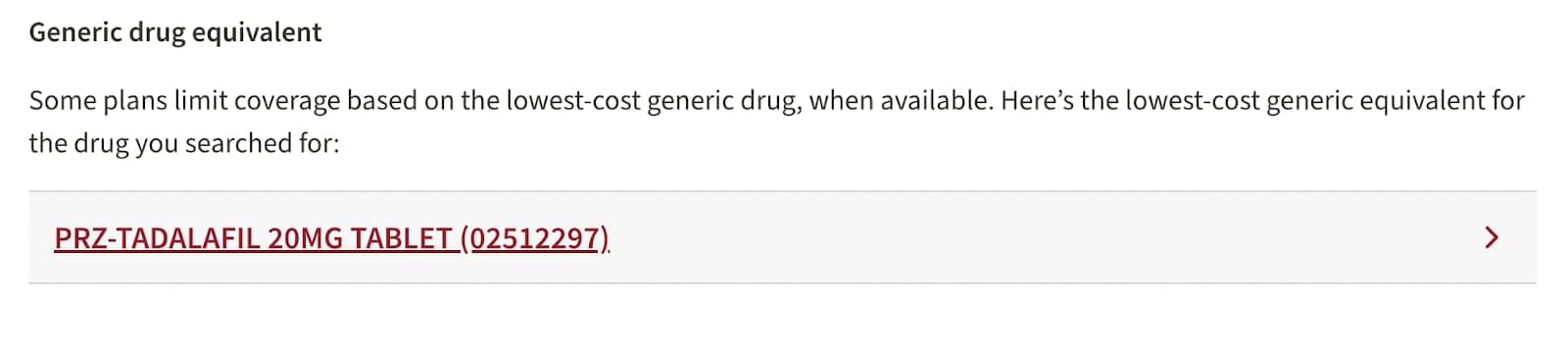
However, it turns out that tadalafil is not covered either.

If you're still not sure whether your private insurance covers tadalafil, the most reliable step is to call your insurance provider and ask them to run a drug coverage inquiry. When you speak with them, ask specific questions so you understand the full picture, such as:
- Do you cover brand-name Cialis or the generic tadalafil?
- Are ED medications excluded from your plan?
- Is tadalafil covered when it's prescribed for BPH?
- Is prior authorization required for coverage?
It's also helpful to ask about deductibles, annual limits, and any maximums that might apply.
Insurance coverage for brand-name Cialis vs. generic tadalafil
Another piece of the insurance puzzle is whether you're using brand-name Cialis or generic tadalafil. Most insurance plans in Canada prefer generics and, in many cases, they will only even consider coverage if the prescription is written for tadalafil.
Why? Brand-name Cialis is simply more expensive.
Also, there is virtually no difference in effect. To be considered a generic medication, it has to meet strict Health Canada standards. Tadalafil, the generic form, has the same active ingredient, the same effect, and the same dosing options as Cialis—but at a much lower cost. So there is no loss of quality—generic medications work *as well *as brand names… you are pretty much paying for the name, not a different medication.
Learn more: What's the Difference Between Brand Name and Generic Medications in Canada?
Insurance companies don't want to pay for the brand name when there is no extra benefit, so if they're going to cover the medication, they're only going to cover the generic version.
Prior authorization for Cialis and tadalafil
Some plans, mainly private ones, ask for prior authorization before they will cover medications like tadalafil. This is basically an extra review step where the insurance company asks your doctor for more information. They're looking to confirm things like:
- The diagnosis
- Why the medication is needed
- Whether other treatments were tried first
- Whether the prescription follows their guidelines
Completing a prior authorization form does not guarantee that they'll cover tadalafil, and the extra information helps them make the decision.
Since many insurers don't cover ED medications for erectile dysfunction alone, Cialis is often denied when it's prescribed strictly for ED. Coverage becomes more likely if it is prescribed for BPH, pulmonary arterial hypertension, or for someone who has more than one of those conditions.
Some plans even specify the 5 mg daily dose for BPH because that's the standard treatment. (Fortunately, that's also the standard dose for a daily tadalafil treatment for ED.)
Learn more: How to get Daily Cialis in Canada
How much does Cialis cost with Insurance?
If it's covered, it's almost certainly tadalafil covered by your private insurance. How much they cover depends on your plan—so check with your insurance company.
How much does Cialis cost without insurance?
Many men won't have Cialis or tadalafil covered by their insurance plans—so how much does it cost without any coverage?
Prices vary a lot depending on the pharmacy, the dose, and whether you're using brand-name Cialis or generic tadalafil. Here's how the costs typically break down for as-needed tadalafil 20 mg:
- Brand-name Cialis: Highest price; you're paying for the name, history, and marketing. It's usually between CAD $17 and $39 per pill.
- Generic tadalafil: Same active ingredient and same Health Canada standards, but dramatically cheaper—between CAD $10 and $20 per pill.
For most men paying out of pocket, tadalafil ends up being the far more practical long-term choice. And because many online clinics bundle medical evaluation, prescription, and shipping, ongoing treatment is usually much more affordable and much easier to access.
How Essential Clinic makes ED treatment affordable
So, is Cialis covered by insurance?
It depends a bit on where you live, whether you have other medical conditions that justify it, and whether your private health insurance is particularly good.
But the short answer is: probably not.
But that's okay, you can get generic tadalafil without a hefty price tag from https://www.essentialclinic.ca. Once approved, your medication is shipped discreetly anywhere in Canada in plain, unmarked packaging. It's a private, reliable, and convenient way to get treatment without interruptions to your day.
If you're ready to explore whether tadalafil is a good fit, you can start your online visit directly through Essential Clinic. Start your online visit.
References
Canadian Agency for Drugs and Technologies in Health. (n.d.). Similarities and differences between brand-name and generic drugs.
Government of Canada. (n.d.). Prescription drug insurance coverage.
Government of Canada, Patented Medicine Prices Review Board. (2025, June). PMPRB releases new Guidelines to monitor and review drug prices - Canada.ca
GreenShield Canada. (2024). Understanding prior authorization.
Health Canada. (n.d.). *Drug Product Database: Cialis (tadalafil) – Product information (*Drug Product ID 2744).
Huang, S. A., & Lie, J. D. (2013). Phosphodiesterase-5 (PDE5) inhibitors in the management of erectile dysfunction. P & T, 38(7), 407–419.
Evans, J.D. & Hill, S.R. (2015).A comparison of the available phosphodiesterase-5 inhibitors in the treatment of erectile dysfunction: a focus on avanafil - PMC. International Journal of Clinical Practice, 69(9), 1072–1080.
Padma-Nathan, H., Eardley, I., Dinsmore, W., Goldstein, I., Giuliano, F., & Lloyd, S. (2004). Duration of action of sildenafil citrate in men with erectile dysfunction. Journal of Sexual Medicine, 1(2), 234–240.
Porst, H., Kim, E. D., Casabé, A. R., Mirone, V., Secrest, R. J., Xu, L., & Sundin, D. P. (2016). Efficacy and safety of tadalafil 5 mg administered once daily in men with erectile dysfunction: Results of an international randomized, double-blind, placebo-controlled trial. International Journal of Impotence Research, 28(5), 171–178.
Urology Care Foundation. (n.d.). Benign prostatic hyperplasia (BPH).
This article is for informational purposes only and does not constitute medical advice. The information contained herein is not a substitute for and should never be relied upon for professional medical advice. Always talk to your doctor about the risks and benefits of any treatment.