Enclomiphene
Enclomiphene: How It Works, Side Effects and Availability in Canada
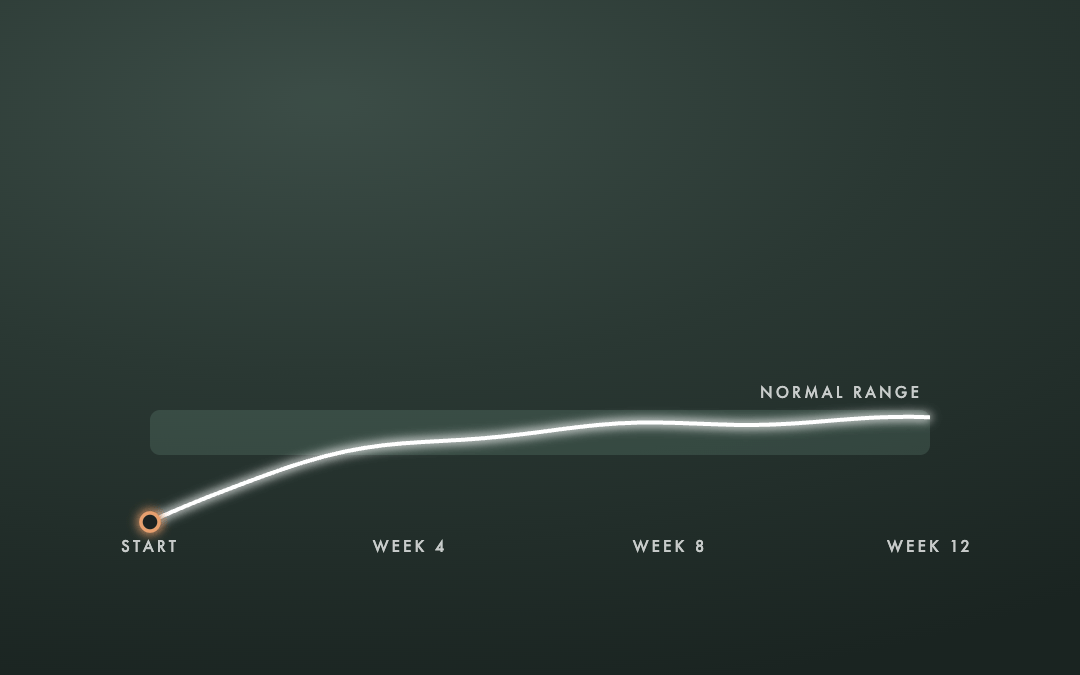
Enclomiphene is a daily pill that helps men with low testosterone make more of their own testosterone. It isn't testosterone replacement therapy (TRT). Instead of replacing testosterone, it signals your body to produce more, which keeps sperm production going.
This guide covers how enclomiphene works, what the research shows, side effects, how it compares with Clomid and TRT, and how to get it in Canada.
Think you have low T? Get checked online by a licensed clinician.
What is enclomiphene?
Enclomiphene, also spelled enclomifene and often called by its full name, enclomiphene citrate, is a selective estrogen receptor modulator (SERM). It's one of the two forms that make up clomiphene, a fertility drug sold as Clomid, and it's the form that raises testosterone.
It's taken once a day, usually as a capsule made by a compounding pharmacy. It doesn't contain testosterone, and it isn't a steroid.
How does enclomiphene work?
Your brain controls how much testosterone your body makes. It sends two hormones, LH and FSH, that tell the testes to make testosterone and sperm. When the brain senses estrogen, it sends less of them.
Enclomiphene blocks estrogen's effect in the brain. The brain then sends more LH and FSH, and the testes make more testosterone and sperm.
That's why it only works when the testes can still respond. It's used when low testosterone comes from weak signals from the brain (secondary hypogonadism), not when the testes themselves aren't working (primary hypogonadism). Blood tests for LH and FSH help your clinician tell the difference.
Does enclomiphene work?
In clinical trials of men with low testosterone:
- Testosterone went up to levels similar to testosterone gel, along with LH and FSH (Kaminetsky, 2013; Wiehle, 2014).
- Sperm counts stayed in the normal range, while testosterone gel lowered them (Kim, 2016).
- The effect wore off when men stopped. Testosterone returned to its starting level within about a month (Kaminetsky, 2013).
There's an important limit. The trials measured testosterone and sperm, not symptoms like energy, sex drive or muscle. That's one reason the European Medicines Agency turned down an application to approve it in 2018.
What are the side effects of enclomiphene?
In trials, side effects were usually mild. Ones that have been reported include:
- Headache
- Nausea or an upset stomach
- Mood changes
- Higher estrogen levels
- Rarely, changes in vision. Tell your clinician right away if this happens.
The European Medicines Agency also noted a risk of blood clots. Clinicians usually avoid enclomiphene if you've had a blood clot or stroke, or have liver disease or unexplained vision problems. You'll need regular blood tests while taking it, just as with TRT.
Enclomiphene vs Clomid
Clomiphene, sold as Clomid, is a mix of two forms: enclomiphene and zuclomiphene. Enclomiphene does the work of raising testosterone. Zuclomiphene stays in the body much longer and acts more like estrogen. Enclomiphene contains only the first form (Earl and Kim, 2019).
| Enclomiphene | Clomid (clomiphene) | |
|---|---|---|
| What it contains | Enclomiphene only | Enclomiphene and zuclomiphene |
| Approved in Canada | No | Yes, for women's fertility |
| Use in men with low T | Off-label | Off-label |
Enclomiphene vs TRT
| Enclomiphene | TRT (injections or gel) | |
|---|---|---|
| How it works | Helps your body make its own testosterone | Replaces testosterone |
| Form | Daily pill | Injections once or twice a week, or a daily gel |
| Your own sperm production | Keeps it going | Lowers it |
| Works if the testes can't respond | No | Yes |
Neither is better for everyone. Canadian guidelines list drugs like enclomiphene as an off-label option for men with low testosterone who want to keep their fertility.
Learn more: What Is TRT? Testosterone Replacement Therapy Explained
Who is enclomiphene for?
Enclomiphene is mainly for men with low testosterone who want to keep their fertility, and that's a lot of men. At Essential Clinic, about 1 in 3 men who come to us about low testosterone say they want children or aren't sure yet.
Your clinician may also suggest it if:
- Your blood tests show low or normal LH and FSH, which points to a signalling problem
- Your testosterone is borderline and you'd rather not start long-term TRT
- You're stopping TRT and want help restarting your own production
It isn't a fit if your testes can't respond to the signal, or if you've had blood clots or a stroke.
Is enclomiphene available in Canada?
Yes, with a prescription. It isn't sold as a Health Canada-approved product, so clinicians prescribe it off-label and compounding pharmacies prepare it. You can get it through your doctor or through online clinics like Essential Clinic.
It isn't approved in the US or Europe either. The FDA declined to approve it in 2015 and asked for new trials, and the European Medicines Agency refused it in 2018.
Don't buy enclomiphene online without a prescription. Products sold that way may not contain what the label says.
Getting enclomiphene through Essential Clinic
Essential Clinic treats low testosterone online in every province and territory except Quebec and Yukon.
- Online visit: tell us about your symptoms, health history and plans for children. The $49 annual consult fee covers your assessment, lab requisitions and a year of clinician care.
- Blood test: take your lab requisition to a lab near you. It checks your testosterone, LH, FSH and other markers.
- Clinician call: a licensed Canadian clinician goes over your results and decides with you whether enclomiphene, injections or gel fits best.
- Delivery: if treatment is right for you, it ships free and discreetly.
- Ongoing care: follow-up blood tests every 3 to 6 months, with your treatment adjusted as needed.
Think you might have low T? Start your online visit.
Questions about enclomiphene
Is enclomiphene a steroid?
No. It isn't testosterone or an anabolic steroid. It helps your body make its own testosterone. Athletes should know it's banned in competitive sport.
Does enclomiphene affect fertility?
It's used to protect it. In studies, sperm counts stayed in the normal range on enclomiphene, while they dropped on testosterone gel.
What is the usual dose of enclomiphene?
In studies, men took 12.5 mg or 25 mg once a day (Kim, 2016). At Essential Clinic, about 3 in 4 patients start on 12.5 mg a day. Your clinician sets your dose based on your blood tests and may adjust it at your follow-up.
How long does enclomiphene take to work?
Testosterone starts to rise within weeks. Your clinician will usually recheck your blood work 2 to 3 months after you start.
What happens if you stop taking enclomiphene?
Your testosterone usually drops back to where it was. In one study, levels returned to their starting point within about a month of stopping.
Can you buy enclomiphene over the counter in Canada?
No. You need a prescription. A pharmacy prepares it from a clinician's prescription, and products sold online without one may not contain what the label says.
What is the half-life of enclomiphene?
Enclomiphene clears from the body quickly, within hours to about a day, which is why it's taken every day. Zuclomiphene, the other half of Clomid, clears much more slowly and can still be detected weeks later (Miller, 2019).
Is enclomiphene the same as Clomid?
No. Clomid contains enclomiphene plus a second form, zuclomiphene, that lasts longer in the body and acts more like estrogen. Enclomiphene contains only the form that raises testosterone.
References
Earl, J. A., & Kim, E. D. (2019). Enclomiphene citrate: A treatment that maintains fertility in men with secondary hypogonadism. Expert Review of Endocrinology & Metabolism, 14(3), 157–165.
European Medicines Agency. (2018). EnCyzix: Refusal of the marketing authorisation.
Grober, E. D., Krakowsky, Y., Khera, M., Holmes, D. T., Lee, J. C., Grantmyre, J. E., Patel, P., Bebb, R. A., Fitzpatrick, R., Campbell, J. D., Carrier, S., & Morgentaler, A. (2021). Canadian Urological Association guideline on testosterone deficiency in men: Evidence-based Q&A. Canadian Urological Association Journal, 15(5), E234–E243.
Kaminetsky, J., Werner, M., Fontenot, G., & Wiehle, R. D. (2013). Oral enclomiphene citrate stimulates the endogenous production of testosterone and sperm counts in men with low testosterone: Comparison with testosterone gel. The Journal of Sexual Medicine, 10(6), 1628–1635.
Kim, E. D., McCullough, A., & Kaminetsky, J. (2016). Oral enclomiphene citrate raises testosterone and preserves sperm counts in obese hypogonadal men, unlike topical testosterone: Restoration instead of replacement. BJU International, 117(4), 677–685.
Miller, G. D., Moore, C., Nair, V., Hill, B., Willick, S. E., Rogol, A. D., & Eichner, D. (2019). Hypothalamic-pituitary-testicular axis effects and urinary detection following clomiphene administration in males. The Journal of Clinical Endocrinology & Metabolism, 104(3), 906–914.
Wiehle, R. D., Fontenot, G. K., Wike, J., Hsu, K., Nydell, J., Lipshultz, L., & ZA-203 Clinical Study Group. (2014). Enclomiphene citrate stimulates testosterone production while preventing oligospermia: A randomized phase II clinical trial comparing topical testosterone. Fertility and Sterility, 102(3), 720–727.
This article is for informational purposes only and does not constitute medical advice. The information contained herein is not a substitute for and should never be relied upon for professional medical advice. Always talk to your doctor about the risks and benefits of any treatment.