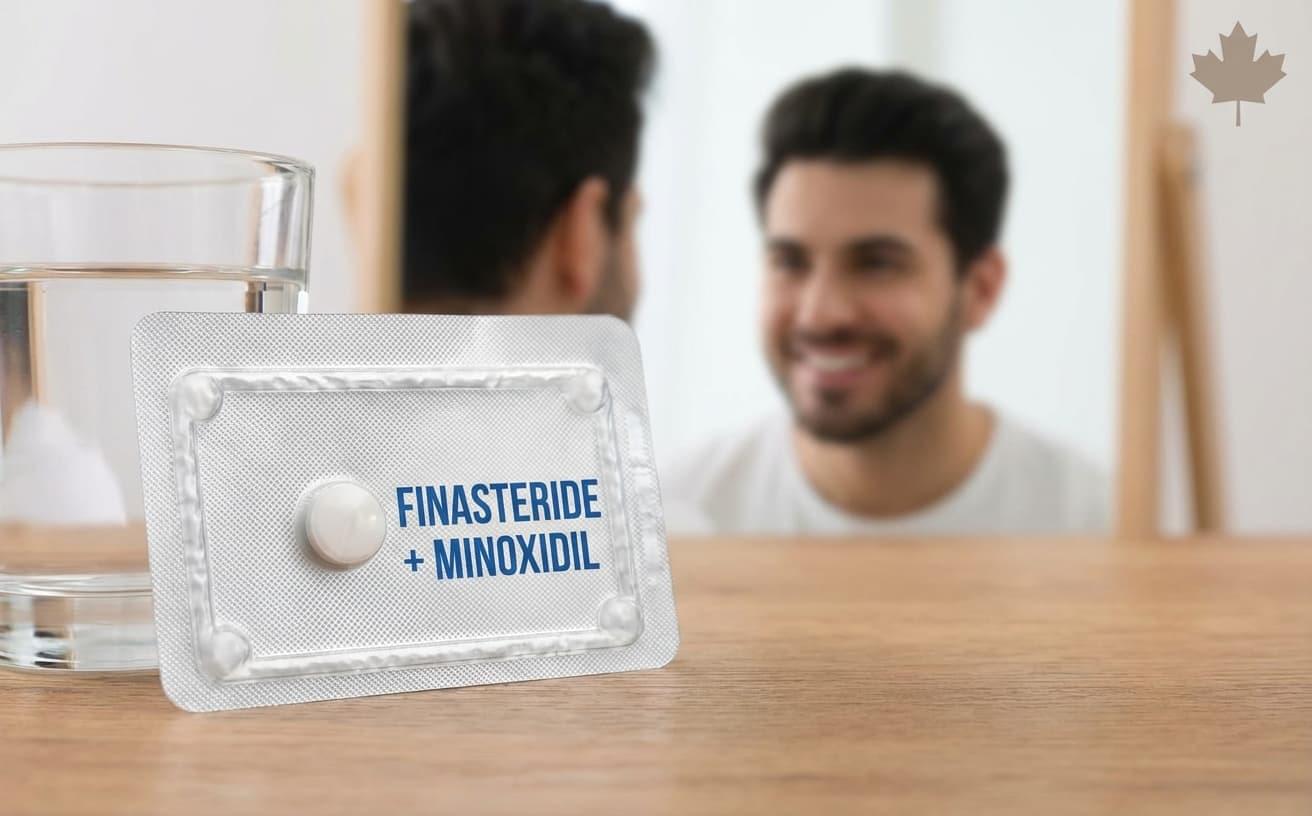
Finasteride & Minoxidil Pill
Finasteride and Minoxidil Pill: Canada’s 2-in-1 Tablet for Hair Loss
Key Takeaways
- Dual-Action Hair Loss Treatment: Combines finasteride (DHT-blocking) and oral minoxidil (follicle-stimulating) into one daily tablet.
- Comprehensive Results: Targets both hormonal and follicular pathways to reduce shedding and support thicker, denser hair.
- Improved Convenience: Offers a once-daily alternative to topical minoxidil and separate finasteride tablets.
- Clinically Supported Ingredients: Both medications have decades of dermatology research supporting safety and effectiveness.
- Ideal for Long-Term Use: Helps stabilize ongoing thinning, encourage regrowth, and maintain results.
- Easy Online Access: Essential Clinic provides quick online consultations and discreet delivery to approved patients across Canada.
Losing your hair?
Hair loss is a common concern among Canadian men—it affects about 50% of us.
But get this: 95% of hair loss in men is treatable.
Two of the most common and evidence-based medications are minoxidil (generic Rogaine) and finasteride (generic Propecia). The combination of oral finasteride with topical minoxidil has been the gold standard for hair loss for years.
Now they come in a convenient finasteride/minoxidil combination pill.
This guide explains everything you need to know about the 2-in-1 finasteride + minoxidil pill: how it works, why men choose it, and how it compares to single-ingredient options.
Ready to try it? Get assessed and buy Finasteride & Minoxidil 2-in-1 Pill online.
A quick primer on hair loss
Male pattern baldness, known as androgenetic alopecia (AGA), is primarily caused by a genetic sensitivity to the hormone dihydrotestosterone (DHT).
DHT binds to receptors in scalp follicles, especially along the hairline and crown, causing them to shrink over time. As follicles miniaturize, each new hair grows in thinner, shorter, and lighter until the follicle becomes inactive.
Read more: Hair Loss in Men: Your Ultimate Guide
The standard hair loss treatments: Finasteride and Minoxidil
Since AGA hair loss occurs as a result of DHT, the most effective treatments work by reducing DHT and stimulating follicles directly.
This is why finasteride and minoxidil have been found to be so effective.
What is finasteride?
Finasteride is a 5-alpha-reductase inhibitor that reduces the conversion of testosterone into DHT—the hormone most responsible for shrinking hair follicles in AGA. By lowering DHT at the scalp, finasteride protects vulnerable follicles and slows further thinning.
Finasteride is usually taken orally as a pill, but you can also apply finasteride topically.
Clinical evidence has found finasteride to be effective:
- Slow or stop hair loss in 90% of men.
- Improve hair density with consistent use.
- Support long-term follicle health.
- Maintain benefits with ongoing daily treatment.
Finasteride is considered a first-line therapy because it treats the hormonal root cause of AGA. It is often paired with minoxidil to target follicle growth as well.
Read more: What is Finasteride? Everything You Need to Know
What is minoxidil?
Minoxidil is a vasodilator originally used for blood pressure. When physicians noticed increased hair growth in patients taking it orally, it became widely studied for male pattern baldness.
Oral minoxidil increases blood flow to the scalp, reactivates follicles, and prolongs the anagen (growth) phase. Minoxidil is also commonly used as a topical liquid or cream. Unlike finasteride, minoxidil does not reduce DHT. Instead, it enhances follicular activity.
Minoxidil supports hair growth by:
- Increasing scalp blood flow.
- Extending the anagen phase.
- Enlarging follicles.
- Supporting regrowth of dormant hairs.
Clinical studies have found that both a low-dose oral minoxidil (0.25–5 mg/day) and topical minoxidil solution can increase density, improve terminal hair count, and show early results in as little as 8–12 weeks.
Better together: A finasteride and minoxidil pill
Because they work on different pathways, finasteride and minoxidil have been used as complementary medications. They are especially effective when used in combination.
Essential Clinic now offers a simplified, prescription-strength approach to AGA: a single daily pill combining finasteride and oral minoxidil.
This dual-action treatment targets both major pathways of male hair loss:
- Finasteride lowers DHT to protect follicles.
- Minoxidil stimulates growth and increases follicle activity.
Together, they support stronger density, reduced shedding, and long-term maintenance. Research found that 92% of men achieved stable or improved outcomes. Over half—57%—achieved "marked improvements".
Benefits of minoxidil + finasteride pill
Benefits of the 2-in-1 combination pill include:
- Improved hair thickness
- Reduced shedding
- Increased density
- Healthier follicles
- Better long-term hair retention
The conclusion of research has been clear: combination therapy outperforms either ingredient alone, with faster and more visible results.
Who Is the 2-in-1 Pill For?
It may be appropriate for adult men with:
- Androgenetic alopecia
- Thinning at the crown or hairline
- A family history of hair loss
- Limited results from topical treatments
- Difficulty applying topicals
- Goals to maximise density and slow long-term thinning
This pill may not be recommended for people with certain cardiovascular conditions, those on interacting medications, or women who are pregnant or may become pregnant (finasteride risk).
A licensed Canadian clinician will review your medical history before prescribing through Essential Clinic.
Read more: How to Get Finasteride in Canada
Finasteride and minoxidil 2-in-1 Pill vs. other treatments
There are several hair loss treatment options—which is the right one for you?
Each treatment works differently, targets a specific part of the hair-loss process, and offers its own advantages for convenience, absorption, and long-term results. Understand how they compare so you can choose what works best for you.
Combination pill vs. finasteride alone
Finasteride reduces DHT—the main hormone responsible for shrinking follicles. However, it does not increase blood flow or nutrients to follicles.
The 2-in-1 pill adds oral minoxidil, giving you both DHT reduction and follicle stimulation.
Combination pill vs. minoxidil alone
Topical or oral minoxidil supports growth but neither treats the hormonal cause of AGA. The 2-in-1 pill addresses both the hormonal and follicular components for more complete results.
2-in-1 Pill vs. Dutasteride
Dutasteride is another DHT-lowering medication sometimes used for male pattern hair loss. It blocks both type I and type II 5-alpha-reductase enzymes, meaning it can suppress DHT more strongly than finasteride.
Read more: Finasteride vs. Dutasteride for Hair Loss
However, dutasteride does not stimulate follicles on its own. The 2-in-1 finasteride and minoxidil pill provides balanced DHT reduction and active follicle stimulation, making it a more comprehensive option.
Side effects of minoxidil + finasteride pill
Finasteride and low-dose oral minoxidil are well-studied, dermatologist-prescribed medications with strong safety profiles when used appropriately. Most men tolerate the combination well.
Finasteride's potential side effects include: decreased libido, reduced ejaculate volume, and mood changes—typically mild, uncommon, and reversible after stopping or adjusting the dose. It is considered reasonably tolerated by men.
Oral minoxidil's potential side effects include: mild swelling, dizziness, increased body hair (hypertrichosis), or temporary shedding during the early growth phase. It is considered safe and effective for hair loss treatment.
Frequently Asked Questions
When will I see results?
Most men see early changes around 3 months, with fuller improvements by 6–12 months.
Do I need a prescription?
Yes. Both ingredients require an evaluation and a prescription by an approved medical professional.
Where can I get the combination pill?
Essential Clinic is an online clinic that can provide an evaluation to see whether the finasteride and minoxidil 2-in-1 tablet is right for you.
Start Your 2-in-1 Finasteride + Minoxidil Treatment
If you're ready for a clinically proven, dual-action hair-loss solution, start your online consultation and learn whether the oral finasteride and minoxidil combination tablet is right for you.
References
Gupta, et al. (2021). Minoxidil: A comprehensive review. Journal of Dermatological Treatment, 33(4).
Johnson et al. (2025). Effectiveness of combined oral minoxidil and finasteride in male androgenetic alopecia: A retrospective service evaluation. Cureus, 17(1), e77549.
Kaufman et al. (1998). Finasteride in the treatment of men with androgenetic alopecia. Finasteride Male Pattern Hair Loss Study Group. Journal of the American Academy of Dermatology, 39(4), 578–589.
International Society of Hair Restoration Surgery. New hair loss treatments in development. ISHRS.
Mella, J. M. et al. (2010). Efficacy and safety of finasteride therapy for androgenetic alopecia: A systematic review. Archives of Dermatology, 146(10), 1141–1150.
Shapiro, J. and Kaufman, K. D. (2003). Use of finasteride in the treatment of men with androgenetic alopecia (male pattern hair loss). Journal of Investigative Dermatology Symposium Proceedings, 8(1), 20–23.
Sobral, M. V. S. et al. (2024). Efficacy and safety of oral minoxidil versus topical solution in androgenetic alopecia: A meta-analysis of randomized clinical trials. International Journal of Dermatology, 64(3), 479-484.
Chen, L. et al. (2020). The efficacy and safety of finasteride combined with topical minoxidil for androgenetic alopecia: A systematic review and meta-analysis. Aesthetic Plastic Surgery, 44, 962–970.
This article is for informational purposes only and does not constitute medical advice. The information contained herein is not a substitute for and should never be relied upon for professional medical advice. Always talk to your doctor about the risks and benefits of any treatment.